
Affordable Acrylic Bead Mixes for Crafts: 2026 Guide
Table of Contents
- How to Compare Acrylic Bead Mixes by Price Per Bead
- Bulk Acrylic Beads: When Buying Larger Packs Pays Off
- Acrylic Beads by Size: Matching Beads to Your Project
- Acrylic Bead Kits: Solving the Color-Matching Problem
- Acrylic Beads for Jewelry Making: Mixing Shapes, Colors, and Finishes
- What to Check Before You Buy: Quality, Safety, and Returns
- Frequently Asked Questions
Last Updated: October 7, 2026
How to Compare Acrylic Bead Mixes by Price Per Bead
The fastest way to waste money on affordable acrylic bead mixes for crafts is to shop by pack price instead of price per bead.
Price per bead is simple math: divide the pack price by the piece count. A $7.00 40-count mixed bag works out to about 18 cents per bead; a $2.50 10-count bag runs 25 cents per bead.

U.S. Small Business Administration guidance on pricing and cost calculation
Why Piece Count Matters More Than Pack Price
Piece count determines your cost. Pack price is marketing; piece count is math.
Here is how our own catalog breaks down on a per-bead basis:
| Product | Price | Pieces | Price Per Bead |
|---|---|---|---|
| 10-20 mm Acrylic Bead Mixed Bag | $7.00 | 40 | $0.18 |
| 16 mm Acrylic Pastel Beads | $4.00 | 15 | $0.27 |
| 16 mm Acrylic Soda Beads | $3.00 | 10 | $0.30 |
| 16 mm Glossy Glitter Beads | $2.50 | 10 | $0.25 |
| Acrylic Flower Focal Beads | $2.50 | 10 | $0.25 |
| 16 mm Acrylic Cardinal Beads | $2.50 | 5 | $0.50 |
| Acrylic Football Beads | $0.40 | 1 | $0.40 |
Bulk Acrylic Beads: When Buying Larger Packs Pays Off
Bulk acrylic beads pay off when you have a repeatable design you will make more than once. If you sell keychains, cup charms, or beaded pens in batches, a larger pack spreads your cost across more finished pieces, but know where the break-even point sits before you commit.
How to Find Your Break-Even Point
The math needs two numbers: your price per bead in the small pack and in the large pack. Subtract the small-pack rate from the large-pack rate, then divide the difference into the price gap between the packs.
Here is how our own catalog breaks down on a per-bead basis:
| Product | Price | Pieces | Price Per Bead |
|---|---|---|---|
| 10-20 mm Acrylic Bead Mixed Bag | $7.00 | 40 | $0.18 |
| 16 mm Acrylic Pastel Beads | $4.00 | 15 | $0.27 |
| 16 mm Acrylic Soda Beads | $3.00 | 10 | $0.30 |
| 16 mm Glossy Glitter Beads | $2.50 | 10 | $0.25 |
| Acrylic Flower Focal Beads | $2.50 | 10 | $0.25 |
| 16 mm Acrylic Cardinal Beads | $2.50 | 5 | $0.50 |
| Acrylic Football Beads | $0.40 | 1 | $0.40 |
A 40-count mixed bag at $7.00 covers several small projects or one large batch. Buying the same 40 beads in 5-count packs costs far more per piece, the whole argument for bulk, but only when you will actually use the beads.

When Bulk Stops Making Sense
One-off gifts are the clearest case against bulk. Making a single keychain for a friend leaves you with 35 beads and no plan for them.
A second case is color drift: you buy a large mixed bag for one project, then find the palette does not match the next project's theme.
A third case is storage and sorting. Large mixed bags arrive jumbled; without labeled containers, you dig through the bag every time you craft and reach for the same handful of colors while the rest go untouched.
A Practical Bulk-Buying Workflow
- Track your last three projects. Note the colors, sizes, and shapes you actually used. If the same green, blue, and pink keep showing up, bulk those. If your palette changes every time, stay small.
- Calculate price per bead for both pack sizes. Use the division method above. Do not compare sticker prices.
- Estimate how many finished pieces you will make. Sellers: count last month's orders. Crafters: count the gifts and swaps on your calendar.
- Multiply beads per piece by finished pieces. A beaded pen might use 8 to 12 beads; a cup charm might use 15 to 25. That total is your real demand.
- Buy bulk only if demand exceeds the break-even count. Otherwise, buy the smaller pack and revisit next season.
Acrylic Beads by Size: Matching Beads to Your Project
Acrylic beads by size fall into three practical ranges, and the range you pick should follow the project, not the other way around. Most listings show a diameter and stop there, leaving two questions unanswered: will the bead fit your stringing material, and will the finished piece look proportional?
The Three Working Size Ranges
- Small, 8 mm to 10 mm: Best for delicate bracelets, layered necklaces, and spacers between larger focal beads. These keep a design from looking bulky.
- Medium, 12 mm to 16 mm: The workhorse range for beaded pens, keychains, and cup charms. Most of our 16 mm acrylic beads sit here.
- Large, 18 mm to 20 mm: Statement pieces and focal accents. These anchor a design and draw the eye.
Hole Size: The Spec Most Listings Leave Out
Hole diameter determines what you can string a bead on. Acrylic beads in the 8 mm to 10 mm range usually have holes around 1.5 mm to 2 mm, fitting elastic cord, thin nylon thread, and most beading wire.

Before buying a mix, check the hole size against your stringing material. Too small and the bead will not thread; much larger than the cord and the bead slides, making the design feel loose.
Matching Beads to Specific Projects
- Stretch bracelets: 8 mm to 10 mm rounds sit flat against the wrist and fit standard elastic cord. Larger beads make the bracelet stiff and prone to gaping.
- Beaded pens: 12 mm to 16 mm beads are the sweet spot. They are large enough to read as decoration but small enough that the pen still balances in the hand. A typical pen body holds 8 to 12 beads depending on barrel length.
- Keychains and lanyards: 16 mm to 20 mm focal beads anchor the design, with 10 mm to 12 mm spacers between them. The larger beads take the wear from pockets and bags.
- Cup charms: 16 mm to 20 mm beads give the charm visual weight so it does not disappear against a tumbler. A charm typically uses 15 to 25 beads depending on the strand length.
- Layered necklaces: 8 mm to 10 mm beads keep the strand delicate. Mix in one 16 mm focal bead at the center if you want a focal point without bulk.
How Size Affects How a Mix Reads
A mixed bag spanning 10 mm to 20 mm gives variety in one purchase, suiting crafters who want options without committing to a single size. A fixed 16 mm pack gives consistency, suiting anyone making the same item repeatedly.
Size also changes visual rhythm: same-size beads read as uniform and calm, while a strand stepping from small to large and back reads as dynamic. Neither is better, it depends on whether you want the piece steady or lively.
16 mm Acrylic Soda Beads 10 pack →
Acrylic Bead Kits: Solving the Color-Matching Problem
Acrylic bead kits solve the problem most crafters describe first: buying beads that do not work together. A curated mix arrives with colors and shapes already chosen to coordinate.
A themed mixed bag, like pastels or glitter, removes that risk.
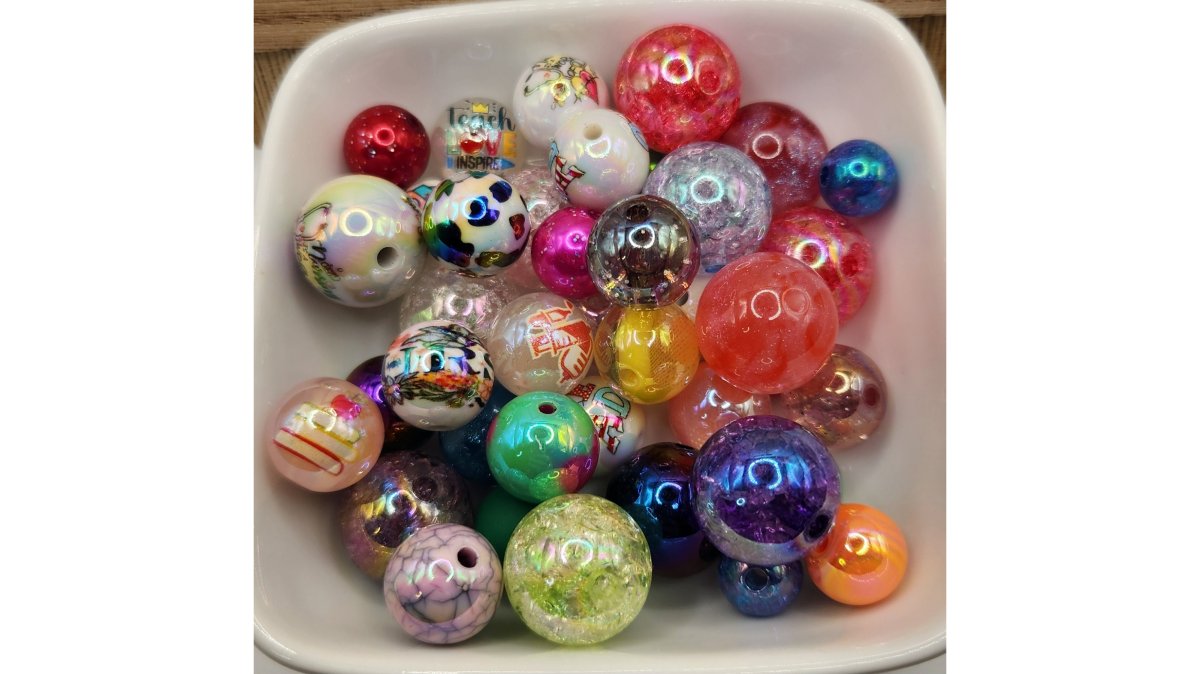
Our DIY kits and mixed bags are built for exactly this. The 16 mm Acrylic Pastel Beads 15ct gives a coordinated soft palette in one purchase, and the 10-20 mm Acrylic Bead Mixed Bag 40 ct covers black, pearl, marble, and woodgrain looks in a single bag, no ordering six separate packs.
Acrylic Beads for Jewelry Making: Mixing Shapes, Colors, and Finishes
Acrylic beads for jewelry making work best when you mix three things: shape, color, and finish. Get all three right and a simple design looks intentional.
Shape variety is where most designs get interesting. Round beads form the base; rondelles add texture between rounds; flower, leaf, and patterned beads break up repetition; and focal beads sit at the center of a keychain, wristlet, cup charm, or lanyard.
Finish changes how light hits the piece:
- Glossy: Bright and reflective, good for bold color.
- Frosted or matte: Softer look, hides scratches better on everyday items.
- Translucent or jelly: Lets color build where beads overlap.
- Glitter: Adds sparkle without a metallic finish.
Color variety ties it together. Pick two or three main colors, then add one neutral or one metallic accent. A multicolor mix does this work for you.
What to Check Before You Buy: Quality, Safety, and Returns
Quality checks take about a minute and save a lot of frustration. Before a large order, look for these signs:
- Smooth edges: Run a finger along the bead hole. Burr-free edges mean no snagged thread and no scratched finish.
- Even color: Check several beads from the same pack. Consistent color means a consistent batch.
- Straight holes: A hole drilled off-center makes a bead sit crooked on the strand.
- Durable finish: Matte and frosted finishes tend to hide wear better than high-gloss on items that get handled daily.
On safety, ask what the material actually is. Acrylic and silicone have different care needs. For anything made for a child, treat small parts as a hazard regardless of material and supervise use.
Returns matter too. Read the policy before ordering in bulk, and check whether the listing says the item is sold individually or as a pack.
Care is simple. Wipe acrylic beads with a soft, dry cloth and keep them away from prolonged water exposure to protect the finish.
Frequently Asked Questions
How can I tell whether an acrylic bead mix is a good value?
Divide the pack price by the piece count to get a price per bead. A 10-count pack at $2.50 works out to $0.25 per bead, while a 40-count mixed bag at $7.00 is about $0.18 per bead. Compare that number across packs instead of comparing sticker prices. Also check the size range and finish, since a mix with larger 16 mm beads naturally costs more per piece than a pack of small spacer beads.
What size acrylic beads work best for bracelets?
For most beaded bracelets, 8 mm to 12 mm beads sit comfortably on the wrist without looking oversized. Larger 16 mm acrylic beads work better for chunky statement designs, beaded pens, cup charms, and keychains. If you are mixing sizes, use the larger beads as focal points and smaller beads as spacers so the bracelet still bends naturally.
Are bulk acrylic bead mixes worth buying for crafts?
Bulk acrylic beads are worth it when you already know which colors and sizes you use most. A larger mixed bag lowers your cost per bead and gives you enough pieces to finish several projects without reordering. If you are still testing color combinations, start with a smaller mixed bag or a themed kit first, then move to bulk once you know what sells or what you enjoy working with.
How many beads do I need to make a bracelet?
A typical adult bracelet uses about 18 to 22 beads at 8 mm, or roughly 12 to 15 beads at 16 mm. Add 2 to 4 extra beads for a focal bead and spacers, plus a few spares in case one has a rough edge. Buying a 40-count mixed bag gives you enough for two bracelets plus leftover beads for keychains or cup charms.
Craft supply shopping rewards patience and math in equal measure. The trick is comparing price per bead, matching size to project, and buying mixes that already coordinate, which is exactly how we built our catalog at Barkers Creative Designs. Browse our acrylic bead mixes and DIY kits to find a pack that fits your next project, and check our discounted and discontinued items for the same quality at a lower price. Search our shop and start building.